
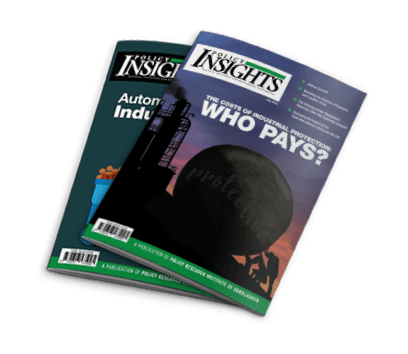
Unlimited Access Is Now Yours
Get one full year of exclusive access to Policy Insights magazine and member benefits.
SUBSCRIBE NOW
Issue 27
February 2026
Bangladesh stands at a critical juncture. After years of macroeconomic shocks compounded by policy missteps and governance challenges, the economy has shown signs of stabilization—but the gains remain fragile and uneven. Since the onset of Covid-19, inflation surged, external reserves fell, the exchange rate depreciated sharply, and GDP growth slowed. Rising unemployment, particularly among educated youth, underemployment, and increasing poverty reflect the human cost of weak macroeconomic management.
The interim government has made notable progress. The shift to a market-based exchange rate and the end of interest-rate controls are landmark reforms that have helped stabilize the balance of payments and contain inflation. The current account is in surplus, reserves have begun a modest recovery, and inflationary pressures have eased. These achievements show that Bangladesh can respond effectively to economic shocks when decisive action is taken.
Yet the broader reform agenda remains unfinished. Fiscal policy implementation has been weak: the tax-to-GDP ratio continues to fall, state-owned enterprises (SoEs) remain a drain on public resources, and energy subsidies crowd out essential social and development spending. Cuts in ADP spending below 4% of GDP have constrained growth, employment, and poverty reduction. Similarly, efforts to improve the investment climate, modernize trade policy, and strengthen micro and small enterprises (MSEs) have lagged, leaving both domestic and foreign private investment subdued. Without meaningful trade reform and export diversification, Bangladesh risks stagnation even as the economy stabilizes.
This imperative has acquired new urgency in light of Bangladesh’s recent reciprocal trade agreement with the United States. The deal—built on asymmetrical reciprocity—commits Bangladesh to sweeping tariff liberalization and expanded imports from the U.S. in exchange for partial and conditional market access for its exports. While it helps avert punitive tariffs and preserves competitiveness in a key market like the US, it also accelerates the erosion of long-standing protection and exposes domestic industries to intensified competition. The agreement thus reinforces a central message of this issue: Bangladesh can no longer rely on high tariff walls and narrow export specialization. Trade policy reform and competitiveness upgrading are no longer optional—they are now externally anchored obligations.
The recent general election offers an unparalleled opportunity. Restoring political stability, rule of law, and judicial independence can rebuild investor confidence and set the stage for sustained growth. But stability alone will not suffice. Bold fiscal reforms, streamlining the tax system, reforming SoEs, rationalizing subsidies, and improving the business environment are essential. Expanding social protection, investing in human capital, and energizing the MSE sector are equally critical for inclusive growth.
Bangladesh’s economic story today is one of partial recovery but unfinished reform. The challenge is clear: to transform macroeconomic stability into sustained growth and shared prosperity, the country needs decisive policy action, institutional reform, and a commitment to long-term structural change. The emerging trade regime underscores that the country must pivot from protection to productivity, from preferential access to competitiveness, and from stabilization to transformation. The coming months will test whether Bangladesh can seize this moment or allow another cycle of missed opportunity.
The focus of this issue is to unpack these challenges and explore the pathways for reform. Drawing on seven in-depth articles, we examine macroeconomic stabilization, fiscal sector reforms, trade and tariff policy, state-owned enterprise restructuring, investment climate improvements, and the role of micro and small enterprises in job creation. Together, these articles provide a roadmap for the next government to translate stabilization into sustainable, inclusive growth.