Addressing the Challenge of Tax Reforms
By
The Need for Tax Reforms
The World Trade Organization (WTO), onThe imperative for Bangladesh tax reforms is illustrated by two striking facts:
First, Bangladesh has one of the lowest tax-to-GDP ratios in the world, and, unfortunately, it has been declining in recent years (Figure 1). Bangladesh collects 6-7% of GDP as taxes, while the average tax rate is 19% of GDP in low-middle-income countries (LMIC) and 12% of GDP in low-income countries (LICs) (Table 1).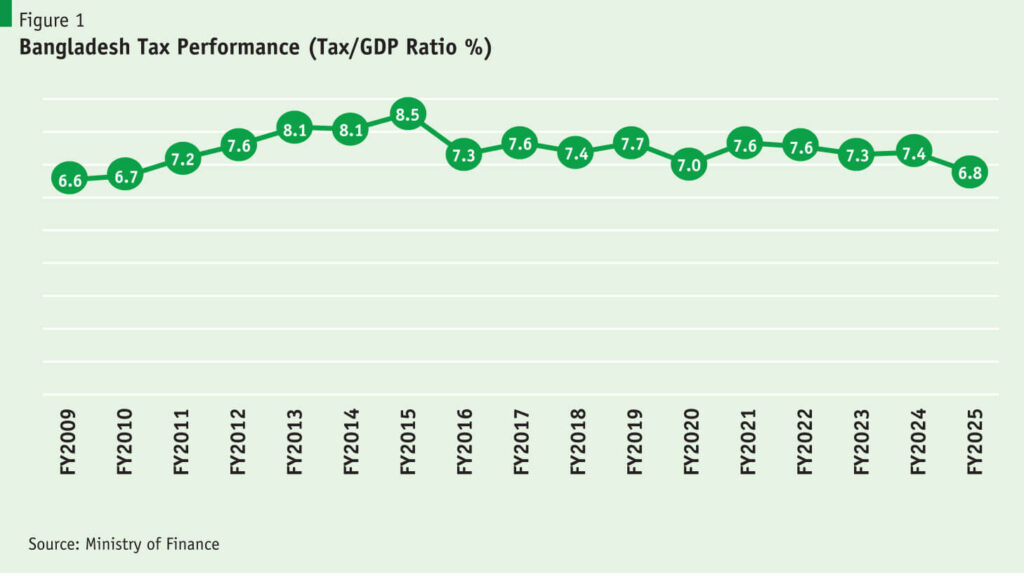
Second, the tax structure is primitive and a negative outlier by international standards (Table 1). While LMICs collect 7% of GDP in income taxes and 8.5% of GDP in VAT, Bangladesh collects only 2.3% of GDP in income taxes and 2.7% of GDP in VAT. Unlike other LMICs, Bangladesh is heavily reliant on trade taxes that distort resource allocation, especially by hurting export industries and favoring inefficient import substitution through heavy trade protection.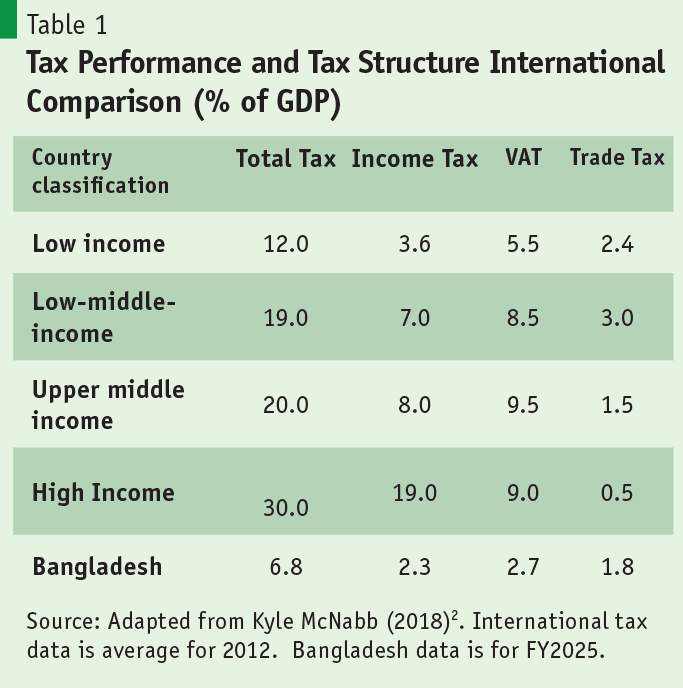
Owing to falling revenues as a share of GDP, the Bangladesh fiscal space, defined as total revenue minus fixed spending commitments expressed as a share of GDP, has been shrinking. Figure 2 provides a snapshot of the prevailing fiscal crisis. In FY2015, fixed spending commitments comprising civil service wages and pensions, interest cost on public debt, supplies and materials spending required for government operation, and transfers to local government institutions (LGIs) to keep them functional absorbed 73% of total revenues, allowing 27% fiscal space for other spending, including development, subsidies, and social protection. In FY2025, the share of fixed spending increased to 76% of total revenues, leaving an even lower fiscal space amounting to a mere 24%. 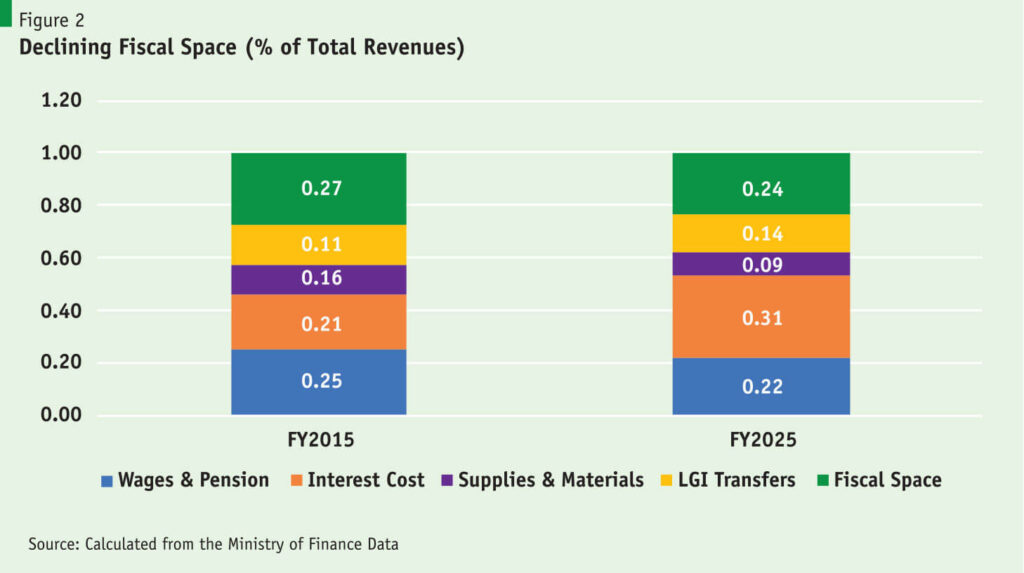
Since the fall in total revenues is much larger than the fall in fiscal space, it is apparent that efforts were made to contain the cost of fixed spending. These spending restraints had the biggest impact on materials and supplies, which are in the nature of O&M spending and are likely to have lowered the productivity of the civil service. Efforts were also made to contain the cost of civil service wages and pensions, and its revenue share was lowered from 25% to 22%. However, the efforts to contain the cost of fixed spending to increase fiscal space were more than fully offset by the sharp increase in the interest cost of public debt, which is now the largest spending item, absorbing some 31% of total revenues. This was 22% in FY2015.
Main Issues and Constraints Underlying Tax Reforms
Level of development and tax handles: The most fundamental tax policy issue is why the tax/GDP ratio has remained stagnant at around 7% of GDP over the past decade or so, despite rapid strides in GDP growth that caused per capita income to accelerate from $843 in FY2010 to $2209 in FY2019 and $2820 in FY2025. The very low tax performance of Bangladesh relative to countries at similar per capita income levels is striking, indicating that Bangladesh is a negative outlier in tax performance (Figure 3). This suggests that the low level of development is not the main concern, but there are other factors at play, including the government’s tax reform efforts, tax administration, and willingness to pay. Indeed, as was observed earlier, the tax performance in Bangladesh is only a third of the average for LMICs and is even below the average for LICs.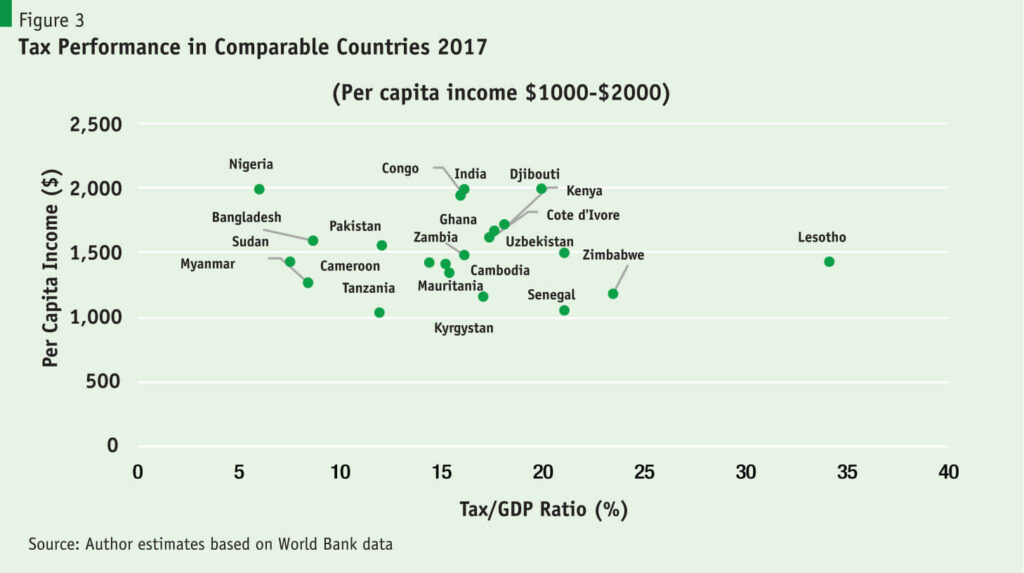
Tax reform efforts and implementation: Tax reforms have generally taken a back seat in Bangladesh. The last major tax reform was done in 1991 when the value-added tax (VAT) was introduced. Since then, the tax system has been occasionally tweaked, particularly in the area of international trade taxes, but the underlying motivation was to reform the heavily protected trade regime, often as a condition for access to international funding. Indeed, once the heavily protected trade regime was brought down to more moderate levels through reductions in customs duties, trade taxes re-emerged as a major tool for revenue mobilization by the introduction of a range of regulatory and supplementary duties. These para-tariffs have mostly over-ridden the beneficial effects of the reduction in trade protection from lower customs duties.
The government sought to re-engage in tax reforms in FY2011 when it announced a major tax modernization plan. This was a fairly ambitious reform effort that sought to modernize the Bangladesh tax system, including reforms of tax laws, tax institutions, tax administration, and capacity building. The record shows there was very little progress with its implementation. Some limited improvement was achieved in the computerization of VAT administration, but overall tax administration remains as constrained as before. In 2012, as a part of its Extended Credit Facility (ECF) agreement with the IMF, the government enacted a new VAT Reform Act that sought to modernize and expand the scope of the VAT. The reform held great promise for improving the efficiency of VAT and raising substantial new revenues but was not implemented owing to opposition from vested interests. The tax capture of elites and politically connected forces remains a predominant constraint to tax reforms in Bangladesh.
Tax administration issues: It is well known that weak tax administration can be a serious constraint to tax resource mobilization in developing countries. A particular challenge is the ability to administer an efficient and progressive personal income taxation system. Thus, a major difference between developing and developed countries is the share of personal income taxation in total tax revenues. High- income developed countries, on average, raise about 16% of GDP as personal income taxes, accounting for about 50% of total tax revenues. As compared to this, LICs collect about 2.3% of GDP, and LMICs mobilize 2.7% of GDP. Bangladesh collected a mere 1.3% of GDP as personal income taxes in FY2025, and this ratio has grown only marginally (it was 1% of GDP in FY2010) even as per capita income grew by more than threefold over those years.
At the heart of the personal income taxation problem is the low level of compliance. Few of the potential income taxpayers actually pay taxes. Tax evasion is particularly large at the highest levels of income. A range of factors explain this tax evasion problem, including legal tax exemptions and loopholes, political connections, corrupt practices, complexities of tax assessment and collection, inefficient tax audits, and high marginal rates of taxation.
In the case of corporate taxes, similar problems exist as for income taxes. An added problem is the large size of the informal economy. Most small and micro enterprises escape the tax net because they operate outside the formal system and are not registered with the government, either through business licenses or through a tax identification number.
Problems of tax administration also affect VAT, especially for small and micro enterprises. The VAT has seen some administrative improvements in recent years through the ongoing tax digitization efforts. Nevertheless, the productivity of the VAT remains low.
Taxes on international trade are more organized and better administered. The main problem here is tax evasion based on corrupt practices. This is a governance challenge that permeates throughout the tax administration.
A generic problem in tax administration is low tax capacity. The National Board of Revenue (NBR) lacks autonomy and is run like any other government department. It is staffed with civil servants. Its primary focus is tax collection through policing and threats. There is no concept of tax service or seeking voluntary compliance through user-friendly approaches. There is very little capacity to do tax policy analysis. Tax changes are made in almost all budgets on a yearly cycle. There is little analysis of the true revenue and resource allocation impact of these changes. Numerous efforts to upgrade the capacity of the NBR with a view to improving tax collection and tax policy analysis have failed owing to a lack of political and administrative support. Frequent changes at the top (chairman of NBR) have further reduced the ability to reform NBR.
Willingness to Pay: Demand Side Issues: It is commonly acknowledged that few people willingly want to pay taxes. Typically, the user-friendly nature of the tax system and the strength of the legal compliance features are the main determinants of tax compliance. Yet, there is empirical evidence that the quality of governance also plays an important role in tax collection. While this is considered a demand-side variable, it works on the supply side as well. Countries that have better governance not only raise citizens’ consciousness and interest in paying taxes as a means to support national development and general welfare, but it also correlates well with cleaner politics and better tax administration, which affects the supply side of the tax effort equation.
Governance challenges facing Bangladesh are well known. For example, the international ranking on corruption prepared by Transparency International (TI) puts Bangladesh at the bottom 18% of countries ranked (147 out of 180 countries) for 2022. The World Bank governance indicators (2022) rank Bangladesh as follows: voice and accountability (28th percentile); Political stability and absence of violence/ terrorism (13th percentile); government effectiveness (23rd percentile); regulatory quality (18th percentile); rule of law (30th percentile); and control of corruption (16th percentile). These suggest that there are major governance issues and challenges in Bangladesh that have constrained tax performance.
Strategic Considerations for Tax Reforms
The Bangladesh tax structure is primitive because it has not been reformed for a long time. Consequently, revenue shortages are creeping up, creating problems for funding core spending in health, education, social protection, water resources, agriculture, and infrastructure. As noted, the last successful tax reform was done in 1991 when the new Value Added Tax (VAT) was introduced as a replacement for sales and excise duties. Another reform effort was attempted in 2011 by the adoption of the Tax Modernization Plan 2011-15, but it was never implemented. A third attempted reform was the planned overhaul of the low-productivity and inefficient VAT system with the new VAT Law 2012. This was a smart move but was not implemented.
There is no tax planning or tax policy analysis capacity. The NBR is responsible for both tax planning and tax collection. It has very little capacity for tax planning and analysis and is mostly geared to tax collection. As a result, tax targets are administratively set at the last minute of the new budget cycle with no relationship to reforms and tax capacity constraints. The NBR scrambles to find easy tax handles and inevitably ends up relying on import duties, the tobacco taxes, bank accounts, mobile phone users, the foreign telecom enterprises, and harassing those who comply with tax laws to pay more. These have caused serious distortion of tax policy for investment, discouraged FDI, created disincentives to the spread of ICT, as it faces the highest tax structure globally, and punished the voluntary taxpayers. 
The income tax structure is complex, discretionary, with multiple exemptions, and ridden with corruption. The concept of universal income as a tax base does not exist because many sources of income are exempt (tax holidays). The tax rates are high, but tax compliance is low. Negotiated informal settlements are rampant, causing a serious revenue erosion. The tax administration has low capacity and functions as a bureaucracy with frequent changes in the NBR chairman. The NBR is run manually with frequent interaction between the taxpayer and the tax collector. Additionally, it is administered in the spirit of a “police” department rather than as a revenue service agency. The income tax forms are complex, and filing requirements frighten many voluntary compliances, as tax filers are scared of facing harassment from NBR. The World Bank Cost of Doing Business has highlighted tax filing as amongst the top 6 negative factors for the high cost of doing business in Bangladesh that discourages FDI.
Recently, NBR attempted to simplify income tax filing through digitization. Yet, the digitized filing process was needlessly complicated by requiring the use of a mobile phone with a SIM card that is synchronized with the National ID card. For most taxpayers, the option of submitting hard copies was eliminated. This is an example of the bad implementation of a good policy. Instead of making online filing simple by using the existing tax ID number and keeping the option of a mail-in hard copy at the discretion of the taxpayer, NBR complicated the process and also removed all flexibility. The tax filing process suffered despite multiple extensions. NBR also ignored feedback from taxpayers to simplify online tax filing and allow submission of hard copies. This is yet another illustration of the lack of service mentality of NBR and the imposition of bureaucratic hurdles.
Critical Reforms of the Tax System
The core tax reforms comprise two elements: strengthening the tax institutions for sustained long-term progress, and reforms of individual taxes to yield higher revenue productivity and lower distortionary effects on incentives.
Tax Institutional Reforms
1) Separation of tax policy from tax collection: An essential institutional reform is to separate tax policy from tax collection. NBR’s single-minded focus on tax collection has come into serious conflict with formulating a broad-based tax policy that is consistent with revenue goals as well as the efficiency of tax collection and implications for incentives and national resource allocation. A better arrangement would be to assign NBR the primary responsibility to collect taxes and give tax policy responsibility to a special unit in the Internal Resource Division. While this reform was accepted by the Interim Government, it remains to be implemented. This is an urgent and high-priority reform that should be fast-tracked. Instead of looking to NBR to implement this reform owing to a conflict of interest, the government should engage with national research institutions to help with this implementation.
2) Strengthening tax policy and tax collection agencies: Both tax policy and tax collection efforts have to be substantially strengthened through the induction of professional staff. The tax departments (NBR and the tax policy unit) need a much better combination of professional and civil service staff. If needed, some additional incentives could be provided to attract fixed-term tax professional experts. This small investment in tax capacity has a high rate of return in terms of better tax policy and revenue performance.
3) Selection and tenure of NBR Chairman: The frequency of changes of the NBR chairman has a serious negative impact on tax collection. The government might want to delink the position from the civil service, select the chairman on a professional basis, and establish a minimum tenure of 4-5 years. This will strengthen the quality of tax administration leadership, depoliticize this position, and provide stability and incentive for the chairman to take tough actions against corrupt practices. Similarly, the head of the Tax Policy Unit should be a competent professional and selected on merit on a fixed-term basis.
4) Fully digitizing tax administration: The full digitization of the tax administration is of the highest priority. While some progress has been made, the digitization process must be consistent with the need to ensure convenience and the least burden for the taxpayer. The NBR must learn from its recent experience with the digitization of income tax and simplify the digitization process. Tax filing must not require anything beyond the existing tax ID for online filing. The option of mail-in or in-person submission of hard copies must be allowed for the convenience of the taxpayer. The benefits of online filing must be obvious to the taxpayer, and not a bureaucratic NBR requirement.
Changing the Structure of Taxes
The main task is to change the composition of taxes away from heavy taxation of international trade (imports) to domestic income and expenditure-based taxes. The expenditure-based VAT reforms have been on the cards for a while. The government is urged to start the implementation of this long-postponed VAT reform in the FY2027 Budget. Trade-based taxation has distorted resource allocation and imparted a serious anti-export bias that hurts the long-term growth prospects for Bangladesh. It is time that Bangladesh makes a serious effort to reduce customs duties and other para-tariffs in the form of supplementary and regulatory duties, starting with the FY2027 Budget.
The fundamental reason government revenue is low is because of inadequate revenues from personal income taxes. Bangladesh collects a mere 1.3% of GDP from personal income taxes while the top 5 percent of the population owns 25% of the total national income. This yields an effective income tax rate of 4%, which is very low. While efforts are underway to improve income tax collection, the effort is concentrated unevenly on fixed-income earners. Personal income from business, capital gains, stocks, and the like tends to escape a fair share of taxation. Similarly, there is minimal tax effort at the local government level. Remarkably, there is no effective property tax collection system. Capital gains from land transactions and stock ownership mostly escape taxation with a nominal levy. The absence of a modern universal personal income tax is a major contributor to the low tax effort in Bangladesh. 
A review of global experience with the taxation structure shows that, on average, developing countries generate 31% of tax revenues from personal income taxation, whereas high-income economies obtain 54% of tax revenues from personal income taxation. In Bangladesh, this is a mere 17%, reflecting its low yield. With solid personal income tax reform, Bangladesh should be able to raise an additional 2-3% of GDP, and its revenue share will go up to 30%.
Reform of Income Taxation
The government should make a serious effort to reform the income taxation regime in Bangladesh, starting with the FY2027 National Budget.
Corporate taxation: Several actions can be taken, including streamlining the corporate tax rate in a series of steps. As a first step, except for tobacco, the maximum rate of taxation should be lowered from 30% to 25% in FY2027 and subsequently to 20%. As rates come down, exemptions and tax holidays for FDIs or specific sectors must be eliminated over a well-defined period so that, by and large, all investors are required to pay taxes. Once the tax rates are lowered and made internationally attractive, exemptions will not be needed. Capital flight to avoid taxation will not be an issue because the investor will have to pay taxes in other countries as well.
Personal income taxation: The personal income reform needs a substantial overhaul based on further research and analysis. The required reform is to lower the marginal and average tax rates and to increase the tax base through voluntary compliance. Bangladesh can learn the positive lessons of personal income tax reforms from other countries. These lessons include:
• The best approach to increasing the tax base is to provide incentives for voluntary compliance. Having high marginal tax rates and putting pressure on only those who pay is a recipe for disaster. It is like killing the goose that lays the golden eggs. Many taxpayers will find ways to escape the tax net by entering into collusive behavior with the tax collectors as presently.
• The tax system must be based on the principle of universal income and self-assessment with productive and selective audits. It must be fully digitized wherever possible, with no interface between the taxpayer and tax collector, except when subject to audits.
• The tax system must be simple with low compliance costs. Indeed, the simpler the system and the lower the tax rates, the more likely there will be voluntary compliance and the less the scope for tax harassment and corruption.
• The audit system should be highly selective and productive. The objective of the audit system should be to discourage tax avoidance rather than serve as an instrument of harassment or to extract a bribe. The audit system should be based on a computer-driven model with well-identified criteria that, if violated, would trigger an audit. The criteria must make the audit productive so that the collection cost is only a fraction of the total taxes raised through audits. It should be highly selective, with no more than 5% of returns audited systematically.
• One example of a bad feature of the tax present tax design that discourages tax filing and leads to harassment, and corruption is the requirement to file a wealth statement based on the balancing of income and expenditure along with the tax return. Many taxpayers find this requirement onerous, and it discourages them from filing taxes because of the fear that this will lead them to various forms of harassment. This also encroaches on the privacy of a citizen. While the government has the right to tax income, it is debatable whether citizens should be required to explain how they spend their money. The value of this dubious requirement for tax collection is negligible and, on a net basis, negative because it discourages tax filing. Importantly there is a common perception that this feature creates incentives for income tax officers to harass taxpayers and extract a bribe. As an example, income tax collections and compliance in the USA are very high, with no such requirement to submit a wealth statement based on a matching of income and expenditure. On the negative side, in Bangladesh, the returns from personal income taxes as a share of GDP have hardly grown over the past 25 years despite a more than tripling of per capita income in dollar terms. It is obvious that the wealth and income-expenditure statements have not helped increase revenues but have tended to support revenue leakages through non-filing and collusion between taxpayers and tax collectors.
• The attitude of NBR should change from tax policing and harassment to voluntary tax compliance based on a user-friendly and tax service approach. This should be combined with productive and computer-based selective audits.
• Self-assessment, digitization, and simplification of personal income tax filing with a user-friendly and service-oriented approach will vastly increase tax compliance and tax collections, as reflected in the experience of countries with good income collection records.
Property taxation: Most upper-middle-income and high-income economies have a well-established system of fiscal decentralization whereby the property taxes are assigned to local governments as the major source of tax revenues. In Bangladesh, this political decision is yet to happen, although imminent, as Bangladesh aspires to attain upper-middle-income status.
• In the interim, the new tax policy unit should design a modern property tax system that is different from the present fragmented two-part system, whereby the NBR collects a wealth tax as a part of the income tax and local governments collect some nominal taxes on properties. A modern property tax that is based on the true market value of properties and evaluated and updated systematically using a computerized property ownership database is an essential element of a modern tax system.
• There are many models of a well-designed property tax system that can be researched and implemented in the specific political economy context of Bangladesh.
• Implementation can proceed in a phased manner with the capital city of Dhaka and then extended to other divisional cities and finally to all urban areas.
Reform of the VAT
The current VAT system is inefficient and low-productivity. The VAT Law of 2012 aimed to change this and convert VAT into a modern system with potentially high revenue yield. It should be implemented in its original form starting from FY2027.